If you’ve been in the fight against trafficking for a little while, you may have heard of the Trafficking in Persons Report (TIP Report hereafter). This provides rankings like we have on our site, listing Cambodia as “Tier 3” and Belize as “Tier 2”. Whether you are new to the mission of fighting human trafficking or you’ve partnered with us for a while, you may have no idea what any of that means! Have no fear, you are in the right place! We are going to dive into what the TIP Report is, what each ranking means, and how this report is useful and helpful in fighting human trafficking globally.
How did it start?

In 2000, the United States’ State Department decided it was time to take substantial action to fight human trafficking in all forms. The Victims of Trafficking and Violence Protection Act of 2000 established guidelines and anti-trafficking policies to “(1) prevent trafficking, (2) protect trafficking victims, and (3) prosecute and punish traffickers” in a subsection known as the Trafficking Victims Protection Act (TVPA). Within this Act, Congress recognized the prevalence of trafficking in the US and worldwide, committed to addressing the evil of human trafficking, and called other countries to do the same. As part of the TVPA, the Secretary of State is required to publish an annual report to rank various countries on their anti-trafficking policies and efforts to eradicate the problem. Hence, the Trafficking in Persons Report was established.
So what exactly is the Trafficking in Persons Report?
As laid out in the TVPA, the report describes each country included and their government’s efforts to eliminate the severe forms of trafficking, the nature and scope of trafficking, and trends in their efforts to combat trafficking in their respective country.* Once reviewed, the country is given a ranking:
- Tier 1: fully compliant with the minimum standards for elimination of severe forms of trafficking in persons.
- Tier 2: not fully compliant, but making “significant efforts” to be compliant with the minimum standards.
- Tier 2 Watch List (created in 2004): as determined by the Secretary of State to “require special scrutiny during the following year” (expanded on below).
- Tier 3: not fully compliant and not making “significant efforts” to be compliant with the minimum standards.*
The report emphasizes that receiving a Tier 1 ranking does NOT imply there is no trafficking in that country, but rather that the country is working to address and eliminate the problem to the standards of the US Department of State and in compliance with the TVPA. Additionally in 2008, the Child Soldiers Prevention Act required the TIP Report to include a specific list of countries that recruit or use child soldiers in their armed forces, police, or other security forces.*
Other requirements of the report include:
- information on how international, multilateral organizations are working to prevent their employees, peacekeepers, and other staff from participating in human trafficking of any form
- data on changing patterns of international human trafficking
- information on emerging issues in human trafficking
- information on practices to eradicate human trafficking that are proven promising
The Tiers – Explained
Tier 1:
Meeting the minimum standards…
So what are the minimum standards (as defined by the TVPA) for a country to try and eliminate trafficking, and what does it mean to be fully compliant? They are broken into the four following standards:
- The first standard is basically that a country’s government has actually laid out legislation that prohibits and punishes human trafficking as a crime.
- Secondly, these crimes must be punished in a way that is consistent and appropriate for the gravity of the evil involved in trafficking a person.
- Thirdly, the punishment for such crimes appropriately deters future acts.
- And finally, the government of the country is making “serious and sustained efforts” to eliminate all forms of trafficking through enforcement and prosecution, victim protection, trafficking prevention, and more.
If a country is thought to be in line with these four standards, it receives a Tier 1 ranking.
Tier 2:
Making significant efforts toward compliance
Now that we understand what the minimum standards are, what does it mean to be making “significant efforts” toward compliance with these standards? Before deeming a country to be non-compliant, the Secretary of State must consider the following:
- Is the country a source, transit, or destination for severe forms of trafficking? If so, to what extent?
- Are public officials involved in the trafficking of persons in their country?
- Given the resources and “capability constraints”, what are reasonable measures to bring the country/government to comply with minimum standards?
- Is the country devoting sufficient budgetary resources to investigate, prosecute, and convict those responsible for trafficking people, while protecting and supporting the victims and preventing future acts?
- Is the country consulting with local and international organizations to provide services for victims and have they taken steps to improve their services?
In considering these questions, the Secretary of State then determines if the country is, in fact, making these significant efforts to comply with minimum standards.
Tier 2 Watch List:
Requiring special security
In 2004, it was decided that a Watch List should be added to the rankings. This list would establish which countries required “special security” in the following year in order to be kept from Tier 3. These are countries in which, (a) the number of victims is significant or significantly increasing without proportional action, or (b) no evidence has been provided to indicate they have increased their efforts to combat trafficking.
Therefore, if a country would otherwise qualify as Tier 2 but meets either of these standards, it will be placed on the Watch List. These countries are placed on the Watch List for a maximum of two consecutive years before being reclassified to Tier 3. Although there were exceptions to this in 2017, it was decided that such exceptions are to be limited and none should be on the Watch List for longer than 3 years.
Tier 3:
Not meeting or making significant efforts toward compliance
In light of previous definitions, Tier 3 is rather self-explanatory. If the significant effort, as listed in Tier 2, is not met, the country is condemned to Tier 3. The real question is, what is the consequence of failing to meet the minimum standards to eradicate human trafficking in a given country? While some believe that the public call-out is enough of an encouragement to stay off the Tier 3 list, there are additional penalties. According to the TVPA, certain foreign aid should be denied to countries that are not in compliance with minimum standards to eradicate human trafficking and are not making significant efforts to do so. These aid restrictions include non-humanitarian and non-trade-related assistance, sales and financing authorized by the Arms Export Control Act, funding for cultural and educational exchange, and more.

These restrictions are subject to Presidential determination and approval. Between 45-90 days of the TIP Reports publication, the President thus decides the extent to which aid will be restricted for Tier 3 countries.
For more information on the restrictions that Tier 3 countries are subject to, visit the US Department of State’s site for the 2024 TIP Report here.
How Does the Trafficking in Persons Report Help Fight Trafficking?
The TIP Report works to shed light on the problem of human trafficking around the world while providing a tangible system to assess the work being done to eradicate it. Though there are some criticisms of its effectiveness and consistency, the TIP Report demonstrates the prioritization of combating human trafficking for many leaders throughout the world. It incentivizes countries to take action to eradicate trafficking by going after traffickers, protecting the vulnerable and survivors, and preventing future acts of this horrendous crime.
Data from the TIP Report
Throughout our website, we share how an estimated 49.6 million people are living in modern-day slavery. On the 2024 TIP Report, it is reported as “Around the globe, an estimated 27 million people are exploited for labor, services, and commercial sex.” These statistics do not account for the 22 million people who are victims of “Forced Marriage” which is often separated from the forms of trafficking that fall under “Forced Labor” by the U.S. Government as well as The International Labor Organization. Forced Labor is inclusive of sexual exploitation or involuntary prostitution. We tend to use the larger, more broad statistic because we have worked with situations of forced marriage, so we see this statistic as more encompassing of all of our work.
Number of Countries per Tier 2011-2024:

2024 Tiers By Country:
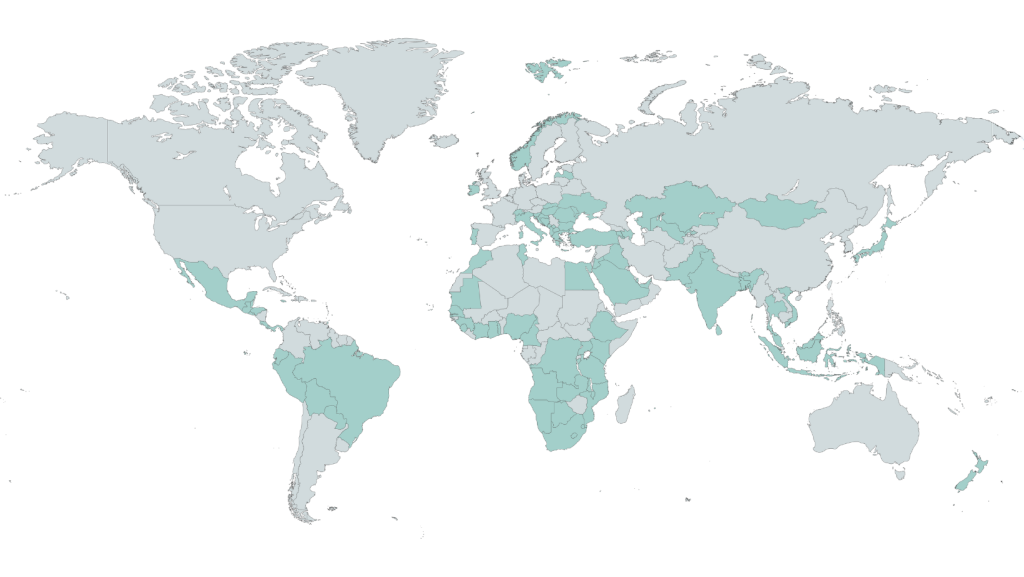 Tier 2 Countries


Distribution of Tiers Across Regions in 2024:


The proportion of countries that have improved, decreased, or stayed consistent in rank:

All data relayed in the preceding images is from TIP Reports 2011-2024 and is meant for visual purposes.
For more information on the Trafficking in Persons report, follow the links below:
*Source
The State Department’s Trafficking in Persons Report: Scope, Aid Restrictions, and Methodology. Congressional Research Service, Oct. 2019.